

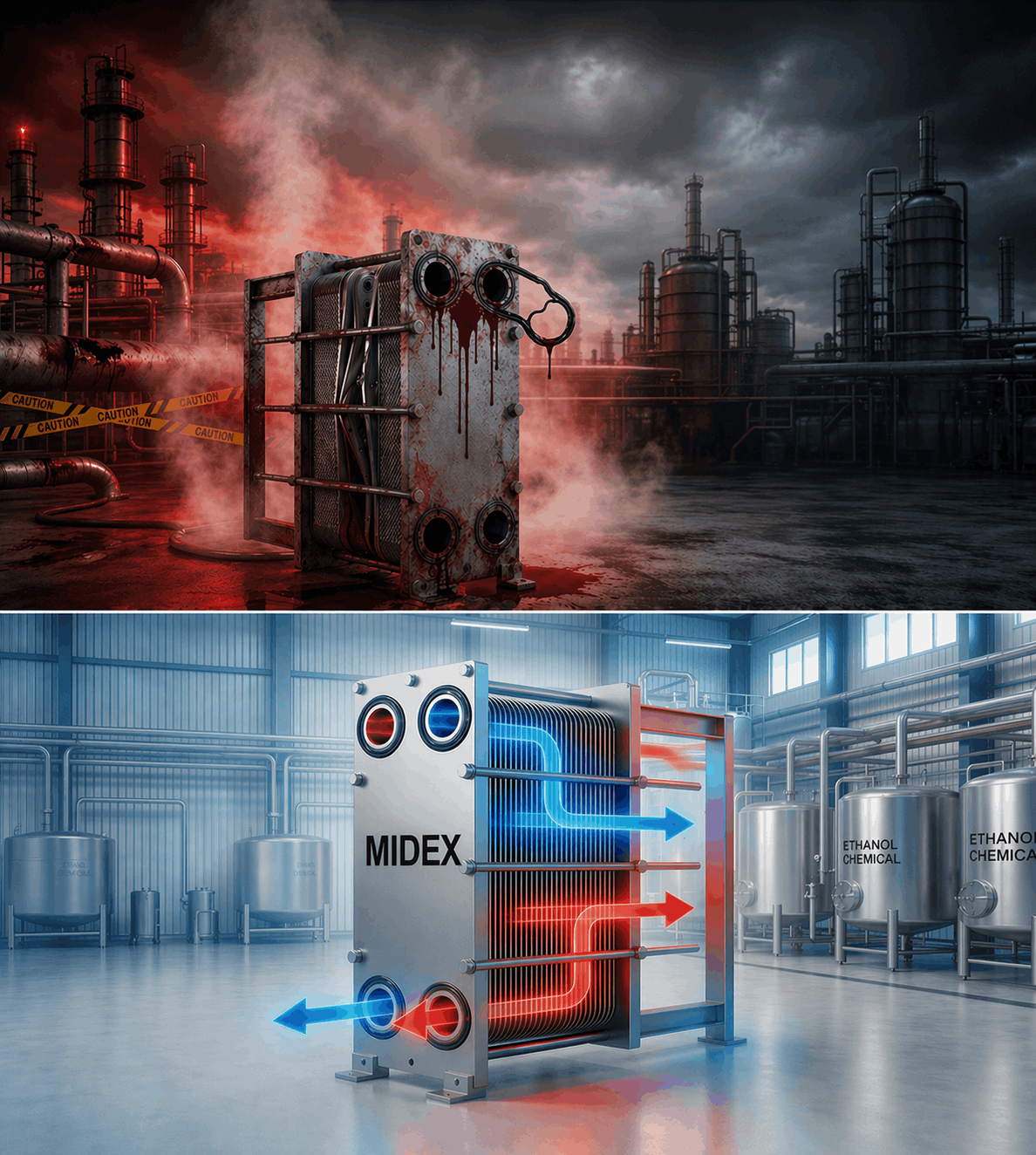
Heat exchangers can be used in high-purity water systems such as PW and WFI, but selecting the right type depends on strict hygienic design requirements and regulatory standards:
- The selection is not only an engineering preference, but a matter of compliance and quality.
- Every component in the loop must prevent contamination and maintain water purity.
- Improper design can lead to serious microbiological and operational risks.
A traditional Plate Heat Exchanger is generally not suitable for these applications due to several design and operational limitations:
- It contains narrow gaps and crevices that may cause water stagnation.
- These areas can promote biofilm formation.
- Effective cleaning and sterilization (CIP/SIP) is difficult for all internal surfaces.
- Some designs cannot withstand thermal shocks during steam sterilization.
- Gaskets may not comply with FDA or USP requirements.
- Risk of extractables and leachables from non-qualified materials.
- Risk of cross-contamination in case of leakage between streams.
In contrast, the Double Plate Hygienic Heat Exchanger is specifically designed for high-purity water systems and offers advanced hygienic features:
- Double plate design with a leak detection zone.
- Any leakage is directed outside the unit instead of mixing fluids.
- Hygienic design ensures full drainability with no stagnant zones.
- Low surface roughness, often electropolished.
- Significantly reduces biofilm formation.
- Materials and gaskets compliant with FDA and USP Class VI.
- High resistance to steam sterilization (SIP).
- Uniform flow distribution with no shadow areas.
- Fully compatible with CIP and SIP processes.
However, Shell & Tube heat exchangers are still widely used in these systems due to their reliability:
- Long proven history in pharmaceutical applications.
- Excellent resistance to thermal shocks.
- Easy steam sterilization (SIP).
- Simple and robust design.
- Suitable for high flow rates.
- Long operational life and easy maintenance.
The Double Plate Hygienic Heat Exchanger also offers important operational advantages:
- Higher heat transfer efficiency than Shell & Tube.
- Faster heating and cooling response.
- Compact footprint suitable for skid systems.
- Lower energy consumption.
- Suitable for precise temperature control applications.
Therefore, a Double Plate Hygienic Heat Exchanger can be used in PW and WFI systems and is often considered best practice, provided that:
- A qualified and reliable pharmaceutical-grade supplier is selected.
- The design complies with hygienic standards (EHEDG / FDA / USP).
- Material quality and internal finishing are ensured.
- The hydraulic design avoids any dead legs or stagnation zones.
- Full compatibility with CIP and SIP is verified.